
Leading Products from Ambiguity to Clarity

Product management is a lot like herding cats. You don’t push them where you want them to go; you lead by letting them think it was their idea.
— Jeremy Perdue
I’m a Product Manager with 15+ years of experience building and evolving platforms across fintech, AI-driven systems, and user experience design. My work spans trading platforms at E*TRADE, customer systems at Charles Schwab, and product development across subscription and live streaming platforms.
I focus on creating systems that are usable, scalable, and grounded in real user behavior, balancing business goals with clarity, trust, and long-term sustainability.
How I Approach Product Management
My approach is grounded in a simple idea: structure and empathy can coexist.
Design with Context. Every decision aligns with the environment, purpose, and users it serves.
Empathy as Data. Qualitative insight is a measurable signal, not a secondary input.
Clarity is a Service. Information should reduce cognitive load, not add to it.
Iteration over Perfection. Progress comes through refinement, not waiting for a final version.
Trust as a Product Feature. In systems involving people and data, trust must be designed intentionally.
Augment, Don’t Replace. Technology should extend human capability, not remove it.
These principles guide how I build and evaluate products, from AI-driven personalization tools to compliance-aligned fintech systems.
I design systems that translate messy, real-world experience into structured, usable outputs. My work sits at the intersection of systems thinking and human experience, where clarity, consistency, and trust are built into the product itself.
Below are selected projects that show how that approach translates into real systems, from AI-driven career tools to compliance-aligned fintech work.
Professional Expression Studio
A modular system for transforming real work experience into reusable professional narratives
Context
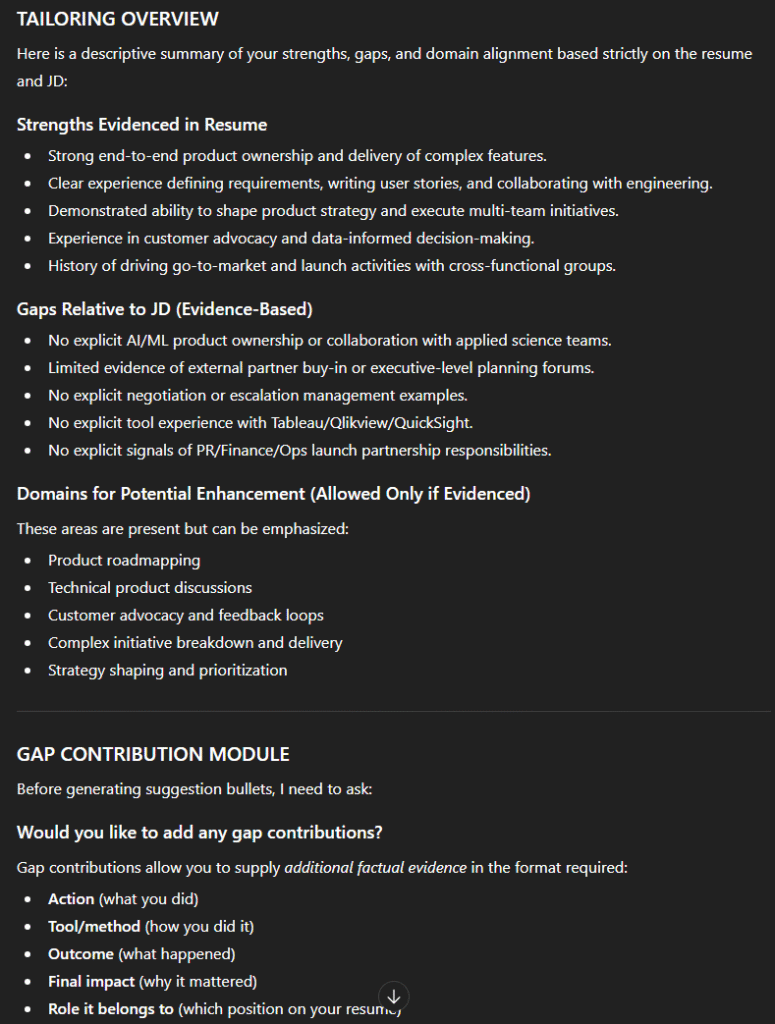
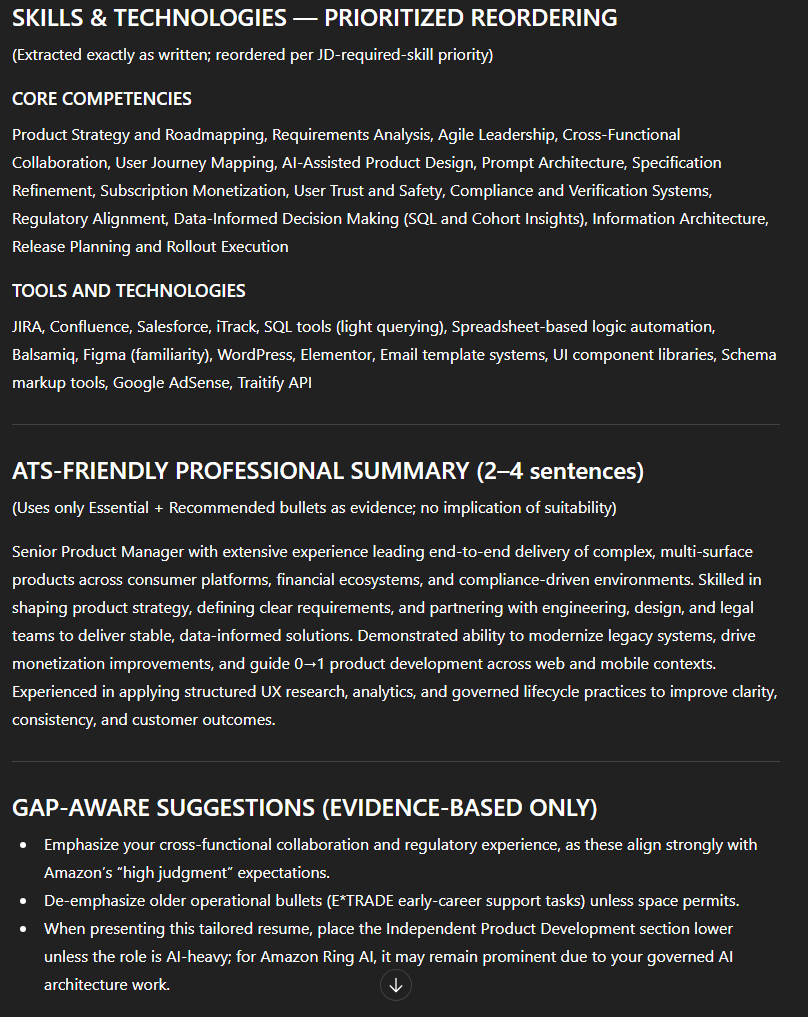
The Professional Expression Studio grew out of a long, messy history of trying to rewrite resumes that never quite matched the truth. Earlier versions of my tools, Career Journey and Resume Tailor, worked, but they operated separately and created drift. The Studio is the unified version: a governed pipeline that captures a person’s actual work before generating anything downstream.
Challenge
Create a system that stops people from reinventing their career story every time they apply for a job. The real difficulty wasn’t writing resumes; it was preventing distortion, contradiction, and unintentional embellishment across versions. The tool needed to protect the user’s voice while enforcing structure and truth.
My Role
Independent Product Manager responsible for strategy, system architecture, conversation design, validation rules, and the integrity constraints that govern the system end-to-end.
Approach
Defined the core principle: truth before expression. Capture the role history, contributions, and outcomes first; tailor later.
Designed a multi-stage workflow that turns stories, resumes, and fragments into a validated career record users fully control.
Built guardrails to prevent common failures: drift, contradiction, fabricated metrics, overwritten voice, and tone leakage between modules.
Iterated aggressively. Early attempts collapsed under too much complexity, prompting several rounds of simplification and forced clarity.
Tested against real resumes, conflicting drafts, and narrative inputs to verify the system could hold structure without inventing anything.
Refined the process until it consistently produced a stable Master Resume file that Resume Tailor could rely on without risk.
Impact
Turned resume rewriting from a draining multi-hour task into a fast, consistent process grounded in truth. Gave users a single source of career clarity that works across resumes, applications, bios, and interviews, all without losing their voice or overstating their experience. The Studio now serves as the backbone for all other tools in the ecosystem.
Reflection
This project proved that building AI for professional expression isn’t about rewriting people; it’s about designing systems that can hold their real story steady. Most of the breakthroughs came from what didn’t work, the bloated prototypes, the prompts that tried to do too much, the early logic that created accidental inference. Stripping the system down to truth, structure, and user control is what made it reliable.

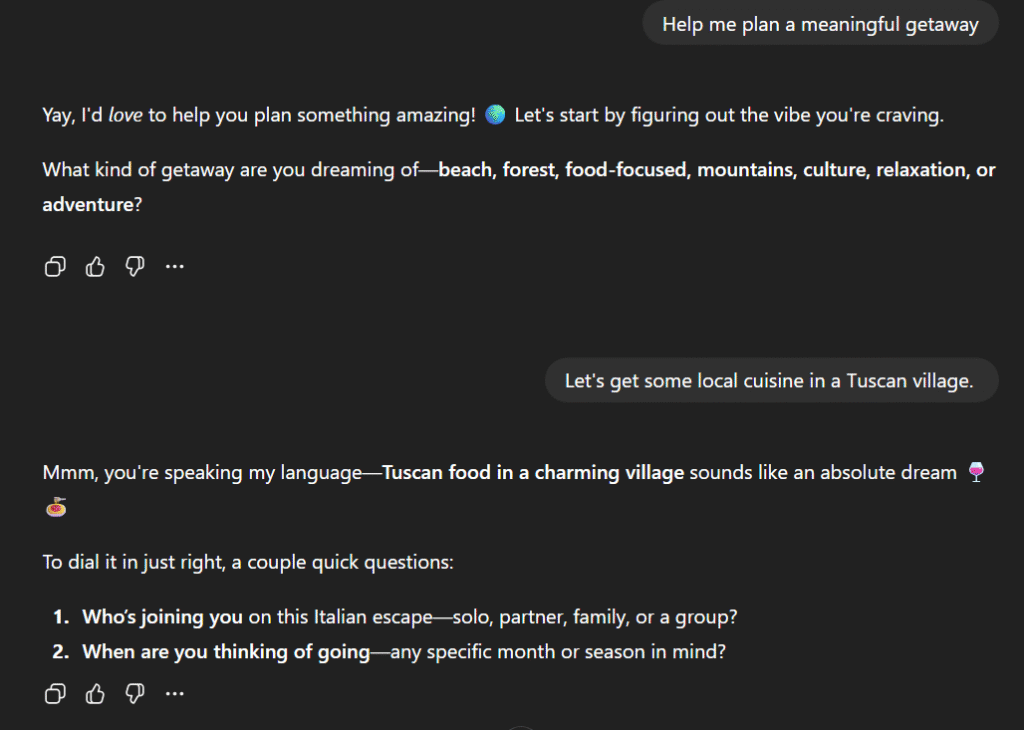
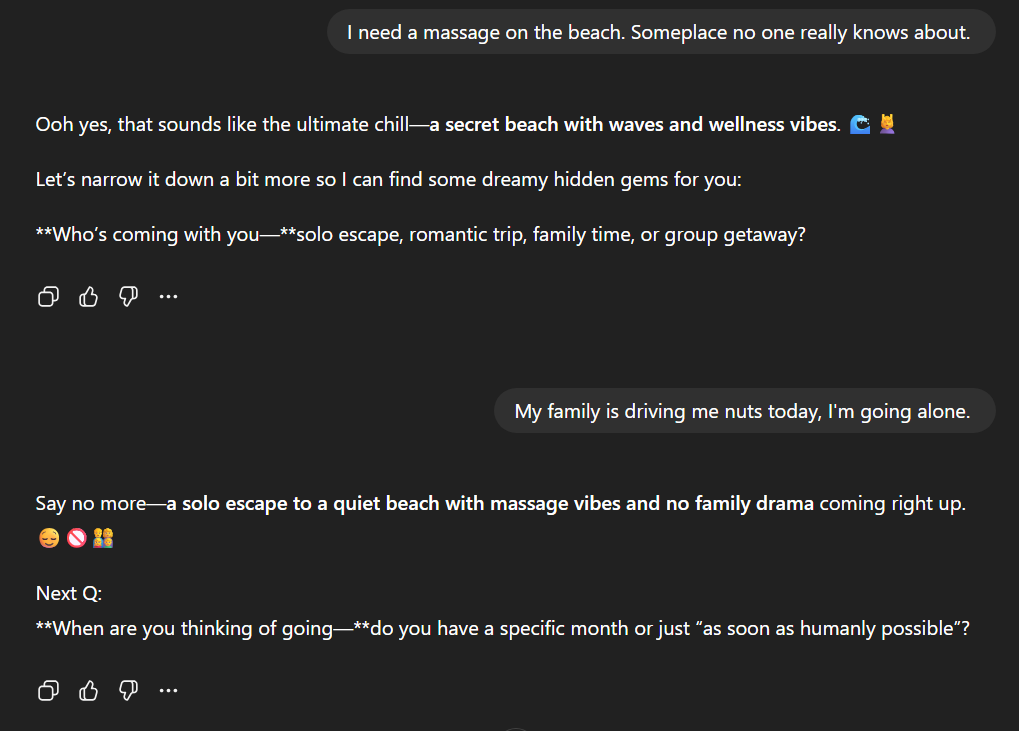
WANDA AI Concierge (Wanderlust Adventure & Navigation Discovery Assistant)
Exploring personalization through conversational design
Context
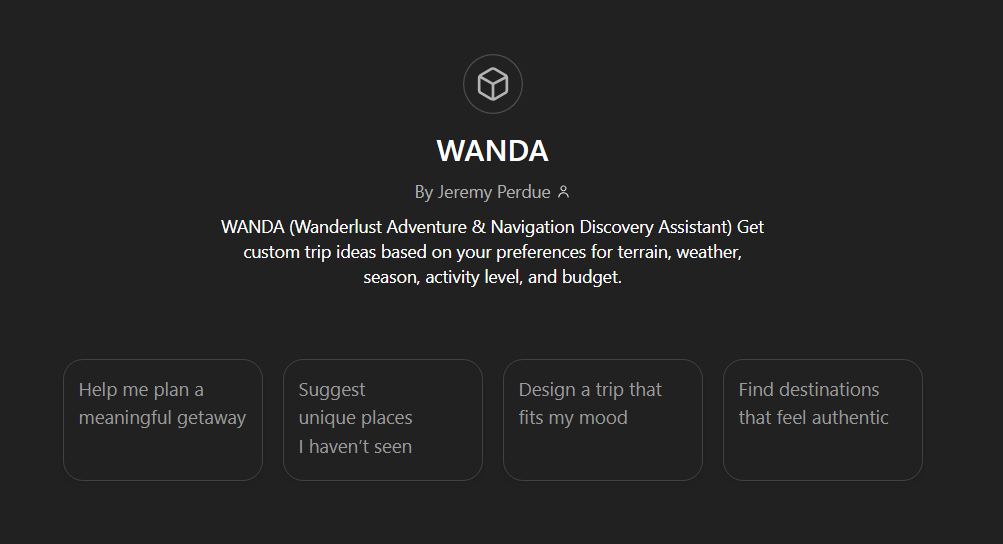
WANDA began as a product experiment within Jeremy’s Journeys, created to test how conversational AI could personalize complex travel decisions. Built on OpenAI’s GPT framework, it functioned as both a prototype and a proof of concept for scalable, ethical AI design.
Challenge
Design a system that could interpret intent and context to deliver meaningful travel guidance, without the rigidity of forms or the chaos of open-ended text.
My Role
Independent Product Manager, strategy, architecture, conversational logic, and validation. Owned end-to-end product direction from problem definition through iterative testing.
Approach
• Defined the product vision and success criteria: reduce cognitive load in travel planning through contextual automation.
• Designed prompt-flow architecture that identifies user goals and dynamically adjusts dialogue paths.
• Implemented grounding methods to maintain accuracy, transparency, and tone continuity across sessions.
• Established iterative test cycles with real travel scenarios to validate usability and reduce edge-case confusion.
• Documented learnings as reusable frameworks, later repurposed for Career Journey GPT and Resume Tailor GPT.
Impact
• Provided foundational architecture for subsequent AI products built around structured prompt logic.
• Validated a scalable model for ethical, context-aware personalization.
Reflection
WANDA proved that product management in AI isn’t about prompts; it’s about systems thinking, experimentation, and designing for trust at every turn.
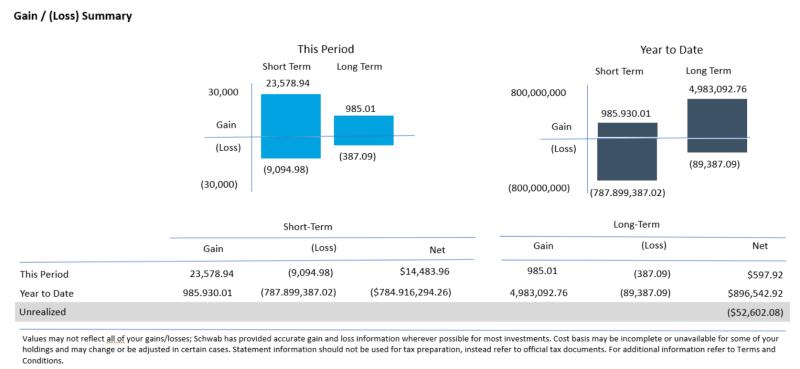
Charles Schwab — Gain/Loss Summary
Delivering clarity and compliance in financial reporting
Context
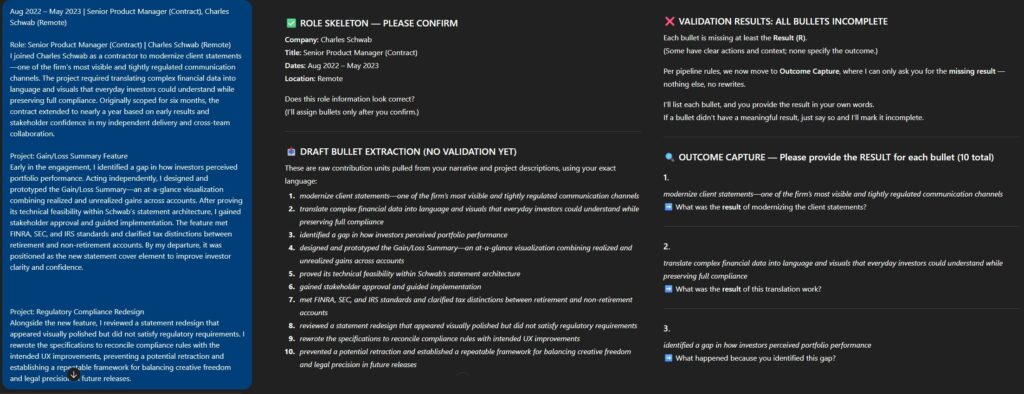
Joined Charles Schwab as a contract Senior Product Manager to modernize the firm’s customer statements, one of the most visible and heavily regulated client touchpoints in financial services. Originally a six-month engagement, the contract was extended to a full year after early success. My focus was on transforming dense financial data into clear, compliant information that everyday investors could trust.
Challenge
Design a feature that simplified portfolio performance without sacrificing regulatory accuracy, a solution that needed to fit within existing statement architecture while meeting FINRA, SEC, and IRS requirements.
My Role
Senior Product Manager (Contract) — concept → prototype → production handoff. Worked with design, engineering, and compliance teams within a large Agile Release Train to define requirements, validate financial logic, and guide execution.
Approach
• Identified the opportunity to clarify how investors viewed gains and losses across multiple accounts.
• Created and prototyped a Gain/Loss Summary, the first visual on every client statement cover page.
• Validated financial logic for retirement vs. non-retirement accounts and aligned language with regulatory disclosure standards.
• Secured stakeholder approval and guided QA through design and implementation.
Impact
• Established the first standardized performance summary for all Schwab client statements.
• Adopted firm-wide as the cover element for millions of investor statements.
• Extended contract based on results and offered rehire for a full-time role.
• Delivered a repeatable model for regulatory-safe UX innovation within compliance-first environments.
Reflection
This project proved that precision and empathy aren’t mutually exclusive; in fintech, clarity is the product. It also affirmed that I thrive equally in contract and full-time roles where measurable impact and collaboration define succes
FFN Inc. — Pricing & Subscription Overhaul
Redefining value through behavioral insight
Context
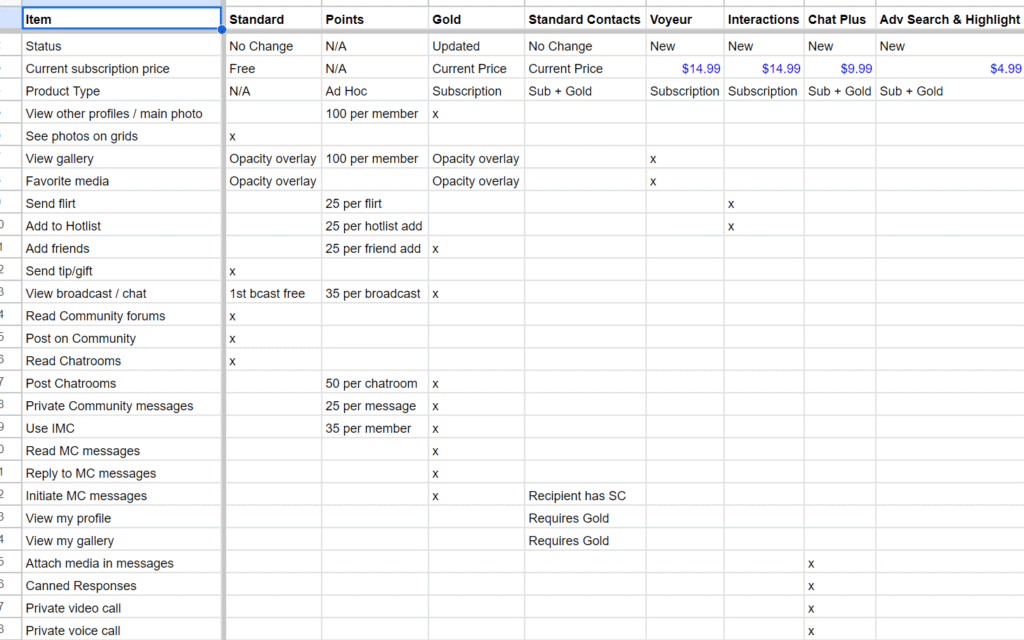
FFN’s subscription model had drifted, with outdated tiers and inconsistent feature gating that no longer matched real user behavior. As the sole Product Manager reporting to the Creative Director, I led a comprehensive redesign of the pricing architecture to align perceived value with how members actually utilized the product.
Challenge
Modernize an aging pricing framework while preserving legacy user continuity. Identify which features drove purchase intent, which added friction, and how competitors packaged similar offerings.
My Role
Product Manager — strategy, research, pricing model design, rollout planning. Cross-functional partner to Analytics and Engineering for implementation and measurement.
Approach
• Ran a competitive landscape audit to benchmark industry pricing, free-tier entitlements, and feature gating.
• Cataloged every platform feature and grouped them into clear value sets aligned to distinct user intents.
• Set prices directly based on feature significance and behavioral indicators (engagement depth, conversion lift, and cohort performance), then validated post-launch.
• Orchestrated rollout with guardrails to keep legacy plans active for existing users and minimize churn risk.
Impact
• +18% new-subscriber revenue in the first quarter of exposure.
• +12% ARPU among cohorts on the optimized pricing model.
• Created a repeatable framework for future bundles, promos, and A/B pricing experiments.
Reflection
Pricing is how a product declares its value, the clearest expression of what it stands for. When structure follows behavior, the offer explains itself.
Military.com — Military to Civilian Transition Plan
Guiding service members through life after duty
Context
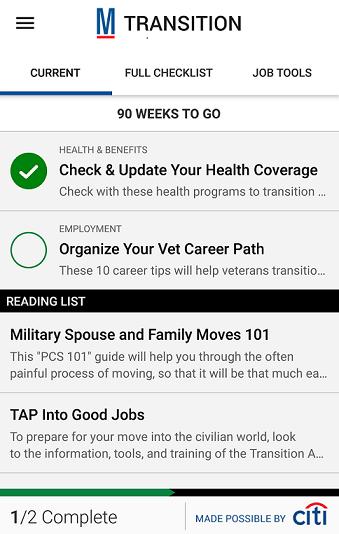
Led development of Transition by Military.com, an integrated platform combining mobile and desktop experiences with a shared backend database. The initiative was conceived by senior leadership but required full product definition, cross-functional coordination, and user-validated design.
Challenge
Build a unified, trustworthy system that helps service members manage the emotional and logistical realities of leaving active duty, all while striking a balance between sponsor visibility and user confidence.
My Role
Product Manager — concept → launch → optimization. Responsible for user research, platform design, sponsorship integration, and engagement strategy.
Approach
• Conducted field feedback sessions with service members, veterans, spouses, and internal teams to capture authentic transition challenges.
• Translated findings into a sequenced checklist experience with empathetic tone and adaptive content.
• Architected a cross-device persistence model so progress synced seamlessly between app and web through a centralized database.
• Partnered with Citigroup to embed contextual financial-readiness tasks without undermining user trust.
• Designed behavior-based notifications using Swrve’s predictive analytics to prompt timely re-engagement.
• Implemented A/B testing on triggers and message variants to measure participation and retention.
Impact
• App maintained a 4★+ rating in app stores.
• Citigroup renewed sponsorship based on user engagement metrics.
• Earned commendations from U.S. congressional leaders for advancing veteran readiness.
• Transformed a static checklist into an adaptive companion supporting high-mobility users during relocation and transition.
Reflection
This project taught me that in mission-critical products, empathy isn’t a feature; it’s the foundation of trust and sustained engagement.

E*TRADE Financial — Pro Tools Navigation Redesign
Turning user confusion into clarity through structured discovery
Context
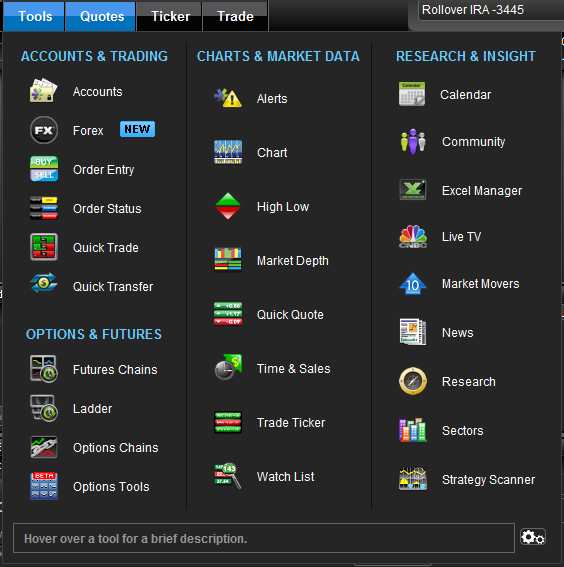
Early in my tenure at E*TRADE, the professional trading platform’s “Pro Tools” navigation had grown cluttered and inconsistent. Years of incremental feature additions had left the interface dense and unintuitive, with essential tools buried in a single banner menu with no means to search.
Challenge
Simplify and reorganize the Pro Tools menu in a way that reflects how real traders think, rather than how developers have grouped features internally. The redesign aimed to reduce friction, improve discoverability, and restore confidence in the platform’s usability, all without disrupting the established workflows of long-term users.
My Role
Product Manager (UX-Focused) — concept → research → redesign. Responsible for user study design, data synthesis, stakeholder alignment, and guiding the engineering and QA teams through implementation.
Approach
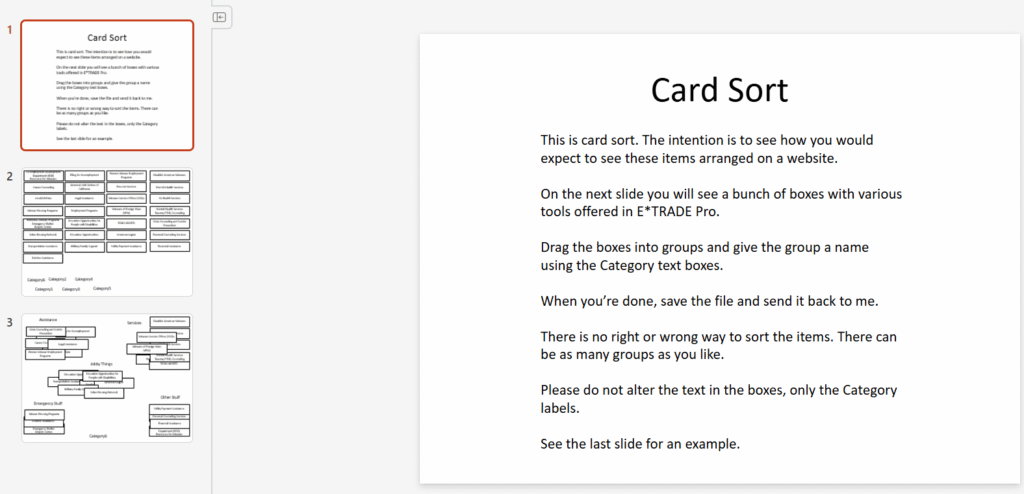
• Designed and conducted a card-sort study with approximately 50 active customers to capture how users mentally grouped the platform’s core tools.
• Partnered with customer service to distribute and collect PowerPoint-based exercises that simulated menu reorganization, enabling participation without specialized software.
• Synthesized findings into clear thematic clusters, translating them into a new logical hierarchy that balanced discoverability and expert efficiency.
• Validated the revised structure through internal pilot testing before final deployment as the “Tools2” navigation system.
• Documented the process to demonstrate the tangible business impact of UX research, helping make the case for E*TRADE’s first dedicated User Experience department.
• Pursued Certified Usability Analyst (CUA) coursework independently through Human Factors International to formalize my growing commitment to research-driven design.
Impact
• Reduced average click depth for core features by 40%, improving tool access time and user satisfaction.
• Decreased navigation-related support tickets, freeing service reps for higher-value interactions.
• Catalyzed the creation of E*TRADE’s UX team, establishing research as a permanent part of the product lifecycle.
• Deepened my own cross-disciplinary perspective, blending product strategy and usability science to guide design decisions.
Reflection
This project taught me that structure isn’t just visual, it’s cognitive. When navigation aligns with a user’s mental model, friction disappears, and trust is restored. It also reinforced my belief that product management and usability research aren’t parallel tracks; they’re the same road, seen from two directions.

Recommendations
Cross-Functional Leadership & Collaboration
“Over the past three years I’ve PM’ed a wide range of products at Military.com, including a lead-generation platform, multiple web tools, mobile apps, and content/SEO improvements. I’m a comfortable bridge between backend APIs and front-end experience, but I especially shine when focused on user experience. In addition, I bring an upbeat, can-do attitude and work cross-functionally with marketing, customer service, designers, and engineers. It’s always been a pleasure collaborating across teams to deliver meaningful results.”
— Jennifer Baik, Director of Product Management, Military.com
User Empathy & Product Delivery
“One of the un-teachable aspects of product management is the ability to empathize with the user — this is a hugely important trait that Jeremy demonstrates consistently. He delivered several high-profile products for our organization that required user experiences serving very different personas while maintaining a simple, effective UI — no easy task, and one he executed beautifully. I’d gladly work with him again in the future.”
— John Rodriguez, Senior Director of Product Management, Military.com
User-Centered Design & Accessibility Advocacy
“I worked with Jeremy for about two years as a product designer while at ETRADE. He was one of the best product managers I’ve had the pleasure of working with — always going above and beyond to understand complex trading products and the needs of his customers. Jeremy was instrumental in advocating for user-centered design, helping to conduct one-on-one usability testing with customers and ensuring accessibility across our interfaces. It was great to work with him, and I’d happily recommend him for any role he pursues.”
— Carrie Lee, Experience Architect, ETRADE Financial
Every project here shares a single idea: that clarity and empathy are inseparable. Whether I’m structuring AI systems, refining pricing models, or guiding people through change, the goal is the same: build trust through understanding. Product management, at its best, turns complexity into something human.
If you’ve read this far, thank you for exploring that journey with me. I’m always open to conversations about products, ideas, and the systems that connect them.